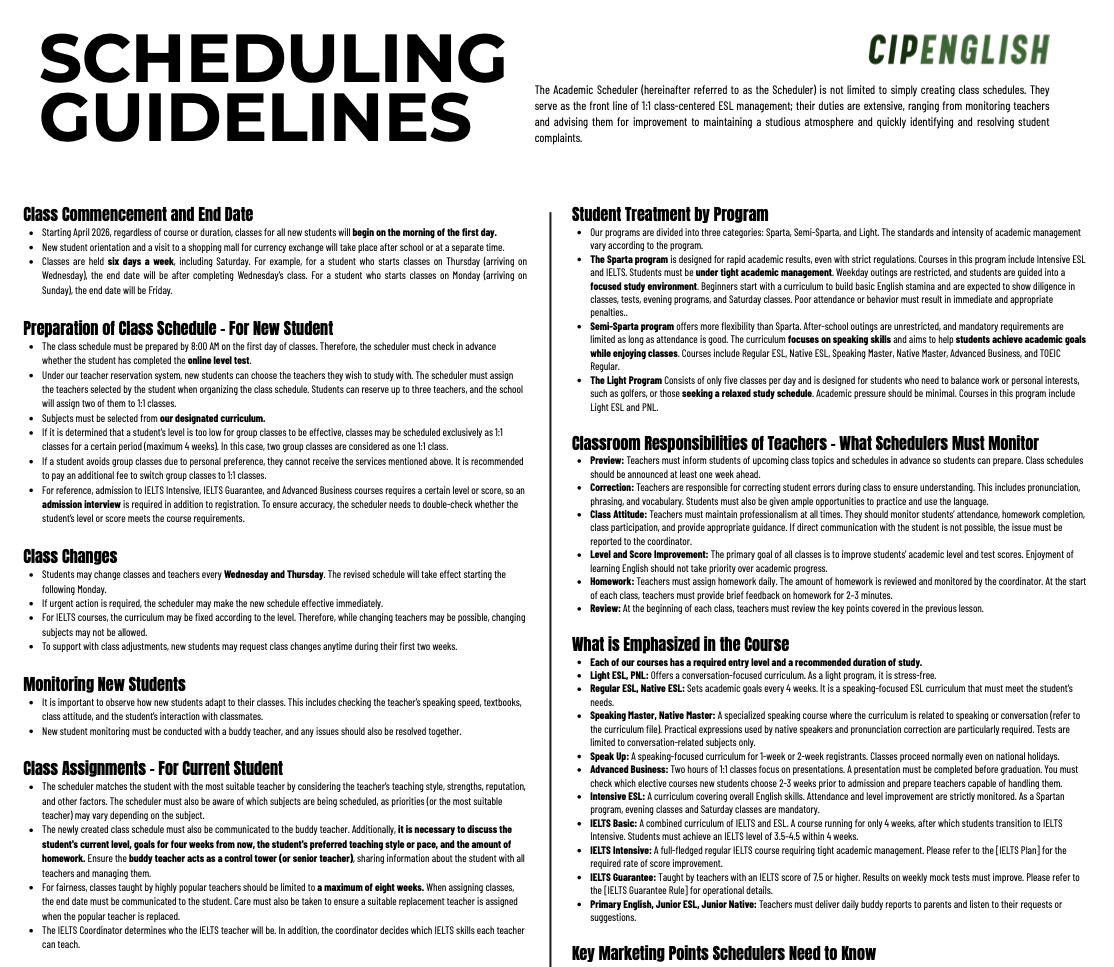
The Academic Scheduler (hereinafter referred to as the Scheduler) is not limited to simply creating class schedules. They serve as the front line of 1:1 class-centered ESL management; their duties are extensive, ranging from monitoring teachers and advising them for improvement to maintaining a studious atmosphere and quickly identifying and resolving student complaints.
Class Commencement and End Date
- Starting April 2026, regardless of course or duration, classes for all new students will begin on the morning of the first day.
- New student orientation and a visit to a shopping mall for currency exchange will take place after school or at a separate time.
- Classes are held six days a week, including Saturday. For example, for a student who starts classes on Thursday (arriving on Wednesday), the end date will be after completing Wednesday’s class. For a student who starts classes on Monday (arriving on Sunday), the end date will be Friday.
Preparation of Class Schedule – For New Student
- The class schedule must be prepared by 8:00 AM on the first day of classes. Therefore, the scheduler must check in advance whether the student has completed the online level test.
- Under our teacher reservation system, new students can choose the teachers they wish to study with. The scheduler must assign the teachers selected by the student when organizing the class schedule. Students can reserve up to three teachers, and the school will assign two of them to 1:1 classes.
- Subjects must be selected from our designated curriculum.
- If it is determined that a student’s level is too low for group classes to be effective, classes may be scheduled exclusively as 1:1 classes for a certain period (maximum 4 weeks). In this case, two group classes are considered as one 1:1 class.
- If a student avoids group classes due to personal preference, they cannot receive the services mentioned above. It is recommended to pay an additional fee to switch group classes to 1:1 classes.
- For reference, admission to IELTS Intensive, IELTS Guarantee, and Advanced Business courses requires a certain level or score, so an admission interview is required in addition to registration. To ensure accuracy, the scheduler needs to double-check whether the student’s level or score meets the course requirements.
Class Changes
- Students may change classes and teachers every Wednesday and Thursday. The revised schedule will take effect starting the following Monday.
- If urgent action is required, the scheduler may make the new schedule effective immediately.
- For IELTS courses, the curriculum may be fixed according to the level. Therefore, while changing teachers may be possible, changing subjects may not be allowed.
- To support with class adjustments, new students may request class changes anytime during their first two weeks
Monitoring New Students
- It is important to observe how new students adapt to their classes. This includes checking the teacher’s speaking speed, textbooks, class attitude, and the student’s interaction with classmates.
- New student monitoring must be conducted with a buddy teacher, and any issues should also be resolved together.
Class Assignments – For Current Student
- The scheduler matches the student with the most suitable teacher by considering the teacher’s teaching style, strengths, reputation, and other factors. The scheduler must also be aware of which subjects are being scheduled, as priorities (or the most suitable teacher) may vary depending on the subject.
- The newly created class schedule must also be communicated to the buddy teacher. Additionally, it is necessary to discuss the student’s current level, goals for four weeks from now, the student’s preferred teaching style or pace, and the amount of homework. Ensure the buddy teacher acts as a control tower (or senior teacher), sharing information about the student with all teachers and managing them.
- For fairness, classes taught by highly popular teachers should be limited to a maximum of eight weeks. When assigning classes, the end date must be communicated to the student. Care must also be taken to ensure a suitable replacement teacher is assigned when the popular teacher is replaced.
- The IELTS Coordinator determines who the IELTS teacher will be. In addition, the coordinator decides which IELTS skills each teacher can teach.
Points to Note When Going Out: Must Read
- When going out, carry only one credit card and the cash you plan to use that day.
- To prevent theft, keep your bag in front of you at all times. Avoid using your mobile phone or opening your wallet in public or on the street.
- If you are robbed, do not resist physically. Please focus on protecting yourself.
- Be respectful toward locals. Avoid shouting, as it is considered rude. In particular, do not call out loudly to tricycle drivers.
- Disputes often happen in clubs or bars. Always confirm prices before placing an order and pay the agreed amount in advance to avoid disputes later.
- If a dispute arises, try to resolve it calmly with a smile. Without proof of innocence, escalation can put you at a disadvantage if authorities get involved.
- Avoid marijuana and online gambling. Both are illegal in the Philippines and may have serious legal consequences.
- Do not engage in prostitution or similar activities—they are often scams and extremely risky.
- Food Safety Tips: Avoid eating street food, as meat freshness may be poor and can cause stomach upset. Also, avoid seafood such as fish and shrimp at inexpensive restaurants.
Buddy Teacher
- Select one of the student’s teachers as a Buddy Teacher (acting as a senior teacher) to serve as a bridge between the teachers and management.
- The Buddy Teacher must have at least 6 months of teaching experience.
- Buddy teachers should encourage the student’s academic motivation through various actions, such as monitoring the student’s study pace, assignment completion, class attitude, test performance, post-test actions, and providing academic advice. In addition, they must frequently share the student’s progress with other teachers.
- Above all, buddy teachers are responsible for helping the student achieve their academic goals. Support them in maximizing results within a limited study period and in enhancing the competence of other teachers.
Level/Score, Tests, Feedback
- Student progress is assessed every four weeks, and the tests are conducted in a manner that minimizes disruption to regular classes.
- After the progress test, students receive a TOR (Transcript of Records). Official feedback and advice from the school are provided through the TOR.
- Weekly tests cover patterns, vocabulary, and syntax, ensuring they are relevant and necessary for students in all courses.
- IELTS and TOEIC students are evaluated through Mock Tests held every Saturday, and error checking and problem-solving are conducted during class time.
- Based on test results and evaluations, students receive feedback such as class changes or counseling, depending on their level progression. Penalties, such as mandatory self-study, may also be applied if necessary.
Tests, Activities
- Progress tests are conducted every Friday; however, for each student, they follow a four-week cycle. TOEIC and IELTS progress tests are replaced by mock tests conducted on Saturdays.
- Progress tests must be conducted in a way that minimizes disruption to regular classes. Time must be set aside after progress tests, weekly tests, and mock tests to review incorrect answers. Answer key analysis should be provided during class time (or at a separate time).
- Regular class schedules may be shortened due to English Day or school events. However, interference with IELTS students’ classes should be minimized as much as possible.
Teacher Reservation
- The privilege of choosing a teacher is quite meaningful for all students.
- New students can reserve teachers (up to 3) through the website. Reservations by new students are given priority over those made by current students.
- Current students can reserve teachers who suit their preferences or are popular, with a limit of up to three (3) teachers. When a student makes a reservation, the scheduler must inform them of the teacher’s strengths and when the class will be available. It is also best to personally inform the student when they are scheduled to meet their chosen teacher.
Changes or Additions to Classes
- Changing from group classes to 1:1 classes requires payment of additional fees. Requests to convert two or three group classes into one 1:1 class without additional fees cannot be accepted.
- Adding classes also incurs additional fees and can only be done if there are enough available teachers.
Student Treatment by Program
- Our programs are divided into three categories: Sparta, Semi-Sparta, and Light. The standards and intensity of academic management vary according to the program.
- The Sparta program is designed for rapid academic results, even with strict regulations. Courses in this program include Intensive ESL and IELTS. Students must be under tight academic management. Weekday outings are restricted, and students are guided into a
- focused study environment. Beginners start with a curriculum to build basic English stamina and are expected to show diligence in classes, tests, evening programs, and Saturday classes. Poor attendance or behavior must result in immediate and appropriate penalties..
- Semi-Sparta program offers more flexibility than Sparta. After-school outings are unrestricted, and mandatory requirements are limited as long as attendance is good. The curriculum focuses on speaking skills and aims to help students achieve academic goals while enjoying classes. Courses include Regular ESL, Native ESL, Speaking Master, Native Master, Advanced Business, and TOEIC Regular.
- The Light Program Consists of only five classes per day and is designed for students who need to balance work or personal interests, such as golfers, or those seeking a relaxed study schedule. Academic pressure should be minimal. Courses in this program include Light ESL and PNL.
Sustaining Student Engagement and Progress
- The stage (school unit) may vary depending on the student’s level. For example, Stage 4 covers intermediate and higher levels, including Business and IELTS; Stage 3 covers pre-intermediate levels and TOEIC; while Stages 1 and 2 cover beginner to elementary levels.
- If there is no improvement in the student’s level or score, management may replace the teacher regardless of the student’s preference.
Classroom Responsibilities of Teachers – What Schedulers Must Monitor
- Preview: Teachers must inform students of upcoming class topics and schedules in advance so students can prepare. Class schedules should be announced at least one week ahead.
- Correction: Teachers are responsible for correcting student errors during class to ensure understanding. This includes pronunciation, phrasing, and vocabulary. Students must also be given ample opportunities to practice and use the language.
- Class Attitude: Teachers must maintain professionalism at all times. They should monitor students’ attendance, homework completion, class participation, and provide appropriate guidance. If direct communication with the student is not possible, the issue must be reported to the coordinator.
- Level and Score Improvement: The primary goal of all classes is to improve students’ academic level and test scores. Enjoyment of learning English should not take priority over academic progress.
- Homework: Teachers must assign homework daily. The amount of homework is reviewed and monitored by the coordinator. At the start of each class, teachers must provide brief feedback on homework for 2–3 minutes.
- Review: At the beginning of each class, teachers must review the key points covered in the previous lesson.
What is Emphasized in the Course
- Each of our courses has a required entry level and a recommended duration of study.
- Light ESL, PNL: Offers a conversation-focused curriculum. As a light program, it is stress-free.
- Regular ESL, Native ESL: Sets academic goals every 4 weeks. It is a speaking-focused ESL curriculum that must meet the student’s needs.
- Speaking Master, Native Master: A specialized speaking course where the curriculum is related to speaking or conversation (refer to the curriculum file). Practical expressions used by native speakers and pronunciation correction are particularly required. Tests are limited to conversation-related subjects only.
- Speak Up: A speaking-focused curriculum for 1-week or 2-week registrants. Classes proceed normally even on national holidays.
- Advanced Business: Two hours of 1:1 classes focus on presentations. A presentation must be completed before graduation. You must check which elective courses new students choose 2-3 weeks prior to admission and prepare teachers capable of handling them.
- Intensive ESL: A curriculum covering overall English skills. Attendance and level improvement are strictly monitored. As a Spartan program, evening classes and Saturday classes are mandatory.
- IELTS Basic: A combined curriculum of IELTS and ESL. A course running for only 4 weeks, after which students transition to IELTS Intensive. Students must achieve an IELTS level of 3.5–4.5 within 4 weeks.
- IELTS Intensive: A full-fledged regular IELTS course requiring tight academic management. Please refer to the [IELTS Plan] for the required rate of score improvement.
- IELTS Guarantee: Taught by teachers with an IELTS score of 7.5 or higher. Results on weekly mock tests must improve. Please refer to the [IELTS Guarantee Rule] for operational details.
- Primary English, Junior ESL, Junior Native: Teachers must deliver daily buddy reports to parents and listen to their requests or suggestions.
Key Marketing Points Schedulers Need to Know
- Trustworthy Native 1:1 Program: Students benefit from the collaboration between native speakers and Filipino teachers. In particular, they can learn pronunciation and practical expressions rooted in Anglo-American culture from native speakers.
- Classes Begin on the First Day: To respect students’ time, regular classes must start on the first day of arrival. New students are required to take a test before admission to ensure proper placement.
- 6-Day Classes a Week: Continuous and repetitive learning is far more effective than short, intensive study periods. For this reason, classes are held six days a week, including Saturdays, to maximize learning continuity.
- Teacher Reservation: Students can enjoy the experience of choosing the teacher that suits them best. Teachers can be booked in advance, ensuring students meet their reserved teacher upon arrival. The option to book popular teachers continues even after admission.
- Pre-Admission Online Class: Adapting to classes after admission can take time. Pre-admission online classes allow students to practice and receive feedback on expressions, vocabulary, and pronunciation they may not have used recently, which helps them adjust smoothly once they arrive at school.
Authority and Responsibilities of the Scheduler
- The Scheduler must act proactively and aggressively in all matters to ensure students achieve maximum academic results. To this end, the Scheduler should foster a competitive environment among teachers and assign the most suitable teacher in any given situation. Therefore, the Scheduler must make differential judgments regarding teachers’ class loads for the benefit of the students.
- In class assignments, a teacher’s experience or rank should not be the primary consideration. Likewise, a uniform approach of assigning the same number of class hours to all teachers should be avoided. It is reasonable to allocate more class hours to relatively “better teachers, ” as this benefits students. A “better teacher” is defined as someone who demonstrates a high level of subject proficiency, excellent preparation and attitude, a strong reputation among students, and recognition from management.
- Most students require “continuity in classes taught by the same teacher. ” Therefore, if a teacher is frequently absent, even for legitimate reasons, the Scheduler must find another teacher to replace them. It is also necessary not to assign new students to him/her for a certain period.
- If a buddy teacher fails to perform their role as a control tower effectively, the Scheduler may replace the buddy teacher.
- As the Scheduler is often the first to detect a student’s class attitude, achievement, attendance, and any signs of dissatisfaction, they must respond promptly and appropriately.
- If a student’s class attitude or attendance is poor, a verbal warning should be given as the first step, followed by a written warning and other measures (such as assigning a stricter teacher, if necessary). A written warning requires the approval of the Coordinator.
- As such, the Scheduler plays a crucial role in the operation of the ESL school and holds absolute authority regarding the assignment of students and teachers to classes.
- On the other hand, regarding serious claims or issues, the Scheduler must follow the instructions of superiors, such as the Academic Director or Coordinator.